
THE 2026 PRODUCT VISION
Power conversion.
Reimagined.
Connect solar, storage and electric mobility through a simpler, modular conversion architecture.
Galvanic
isolation
Fewer conversion
components
Lower system
cost potential
High efficiency
by design
CONNECTED ENERGY, IN MOTION
A new flow
of possibilities.
From a solar-powered home to a remote drone dock. See the NexVolt vision in our English narrated product film.
English voiceover & music. Optional English captions in the player.
Download filmRead the film narration
NexVolt. Power conversion for connected energy. Current Booster technology combines galvanic isolation with precise current control. Fewer conversion blocks and connections create a route to lower system cost. NexVolt's twenty twenty-three material reports ninety-six percent or higher efficiency, depending on the application.
Capture solar surplus. Store it, and deliver power when your site needs it. Integrate solar into buildings, vehicles and remote systems through a compact conversion interface. Power drone operations with solar and storage, from remote docks to field battery charging.
At home, coordinate rooftop solar, battery storage and a compatible electric vehicle. Charge your car. Power your home. Support approved grid services with compatible equipment. For workplaces and fleets, combine solar canopies, battery storage and managed charging.
Explore resilient energy for defence bases, communications shelters and field support facilities. Supply drone battery charging in the field with portable solar and stored energy. A modular conversion architecture gives manufacturers flexibility to design around the application. NexVolt. Explore Current Booster integration for your next energy system.
ONE ARCHITECTURE. MANY APPLICATIONS.
Energy, where
it matters.
A conversion core that gives system designers new possibilities across six connected energy applications.
Take solar energy
further.
Solar and battery storage can power drone operations far beyond a conventional plug socket. Explore compact conversion for remote docks, field charging and solar-assisted platforms.
- Solar-backed docking and battery charging
- Remote inspection of solar farms and infrastructure
- Power interfaces for solar-assisted UAV concepts
Flight endurance and onboard solar contribution depend on aircraft design and operating conditions.

Store the surplus.
Unlock its value.
Connect solar generation and battery storage to deliver energy when the site needs it. A modular conversion approach can simplify the interface between different voltage domains.
- PV-to-battery and battery-to-load conversion
- Site energy management and peak demand support
- Scalable conversion concepts for distributed storage
Complete systems require compatible BMS/EMS, protection and application-specific ratings.

Make more surfaces
work for you.
Bring solar into buildings, remote equipment and mobility platforms. Compact conversion interfaces can help designers connect distributed PV to useful storage and loads.
- Building-integrated and balcony solar concepts
- Distributed PV connections to battery systems
- Remote solar power for sensors and drone docks
PV tracking, environmental protection and grid connection requirements are system design tasks.

Your roof. Your battery.
Your car. Connected.
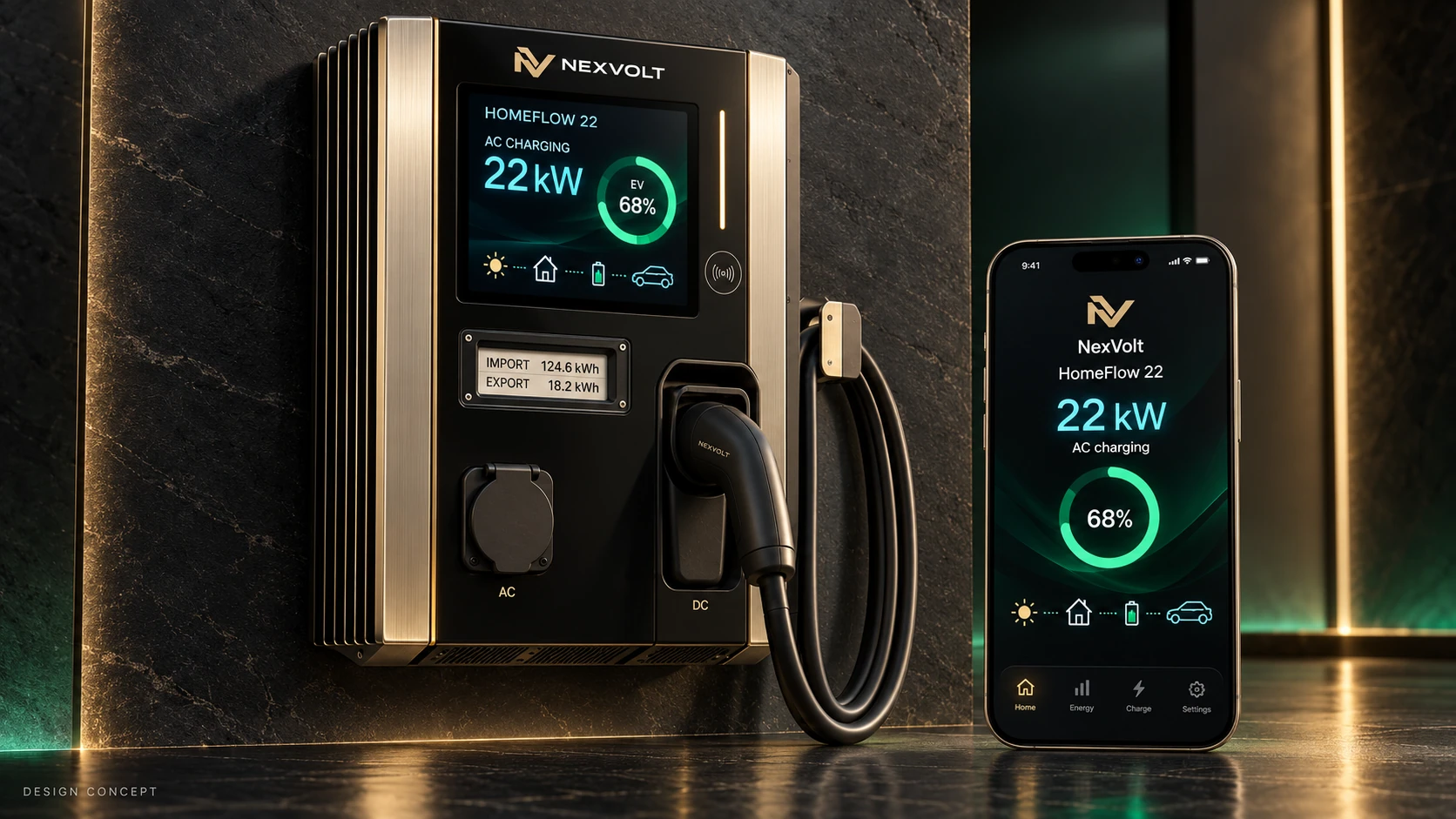
Coordinate rooftop solar, home storage and bidirectional vehicle charging. A compatible EV can become an additional energy source for the home and an asset for approved grid services.
- Solar self-consumption and home battery storage
- Vehicle charging and compatible vehicle-to-home
- Vehicle-to-grid through approved equipment and controls
V2H/V2G require compatible EV/EVSE. Backup needs an approved islanding/transfer arrangement.

Turn parked energy
into possibility.
Combine solar canopies, stationary batteries and managed EV charging. Explore energy balancing across the site and eligible grid services through a coordinated system.
- Solar-backed workplace and fleet charging
- Storage-assisted management of charging peaks
- Approved balancing and export with compatible systems
Grid participation depends on local approvals, metering, controls and operator requirements.

Bring energy
to the mission.
Explore solar and stored energy for defence support infrastructure: base facilities, communications shelters, field equipment and drone battery charging.
- Portable solar + storage for drone charging
- Power interfaces for communications and sensors
- Auxiliary energy for field support and logistics facilities
Proposed integration uses; military qualification, ruggedisation, EMC and security assessment remain application-specific.

THE CURRENT BOOSTER ADVANTAGE
Precision at the core.
Simplicity in the system.
A patent-described architecture that brings isolation, current control and compact magnetic integration into one conversion concept.

Modular converter concept · illustrative assembly
Source-reported efficiency
NexVolt 2023 material. Application-dependent; a reference figure, not a guaranteed 2026 product rating.
01 Galvanic isolation +
Electrical separation between primary input and the secondary side is described in the Current Booster patent. Isolation ratings and safety compliance depend on the finished system.
02 Precise, reversible current control +
Synchronous switching coordinates the primary and secondary. Controlled secondary current polarity supports flexible conversion design. Bidirectional AC/DC and DC/DC applications are described in NexVolt material; a complete V2G system also requires compatible controls and equipment.
03 Fewer parts. Lower cost potential. +
NexVolt's system concept aims to reduce conversion blocks, connections and cabling. Less hardware and assembly can lower overall system cost. Savings depend on the design and bill of materials; no fixed price or saving is promised.
04 Less size and weight +
The patent describes PCB-embedded secondary windings, ferrite/shared cores and stacked PCB assemblies to improve coupling and reduce parasitic effects. Operation at 30 kHz or more, preferably 50 / 100 kHz or higher, provides a route to smaller transformers and lighter assemblies. Actual size and weight depend on the implementation.
05 Current boost through turns ratio +
Primary-to-secondary turns ratios of at least 5:1, preferably 10:1 or more, are described for current transformation. This exchanges voltage for current within the conversion process; it does not create additional energy.
06 Modular architecture, scalable integration +
Series-connected primary and parallel-connected secondary assemblies, carriers and a common primary/control module give designers options for scaling and integration. Half-bridge or full-bridge primary circuits and low-resistance FET choices are also described. Ratings, cooling and protection are defined for the application.
07 Efficient transfer & battery balancing +
Higher conversion efficiency means less energy lost during transfer. NexVolt's 2023 material reports 96–98% for battery-string balancing and illustrates an EV conversion comparison of approximately 90% to better than 96%. These are historical, application-dependent comparisons with different operating conditions, rather than independent 2026 ratings. Polarity adjustment and controlled energy transfer are opportunities for BMS-led storage integration.
08 High-current test equipment +
The patent also describes high AC/DC current generation for electrical testing, with lightweight and portable equipment as design objectives. This extends the architecture's possibilities beyond energy systems to application-specific current injection and test equipment.
Technology basis: supplied Current Booster patent SE544970 C2 and NexVolt 2023 source material. Commercial advantages and application concepts require system-level validation.
SOLAR + STORAGE + DRONES
Energy on the ground.
Possibility in the air.
Remote docks. Field charging. Solar-assisted flight concepts. Connect drone operations to a broader energy ecosystem.
Solar UAV reference concept · no endurance claimDESIGN THE NEXT ENERGY SYSTEM
Let's turn potential
into your application.
Tell us what you want to connect. Explore the power, voltage and integration requirements for your next product.
NexVolt
2026
Luxury product presentation
30 pages · PDF · 23 MB